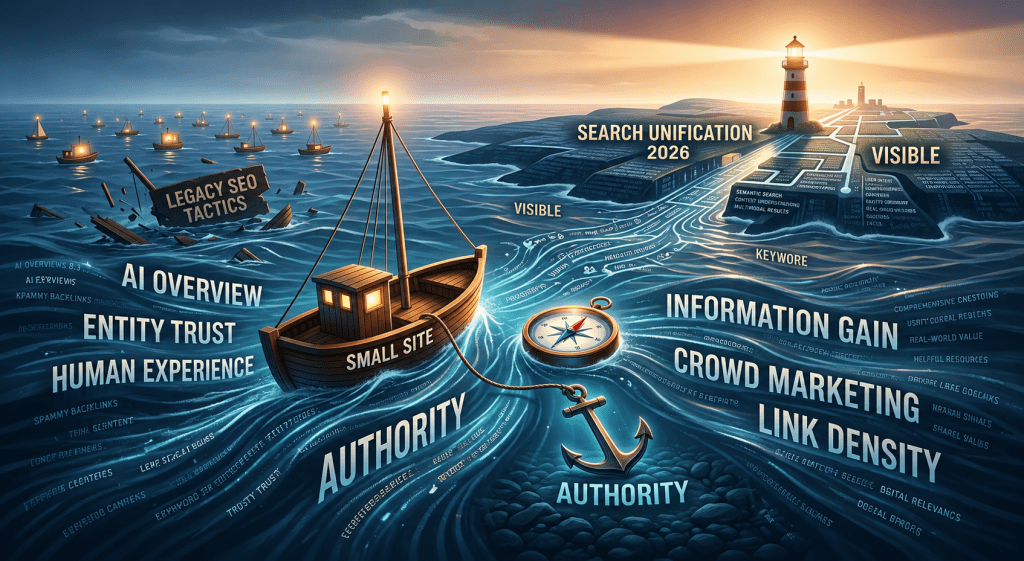
The digital landscape has undergone a seismic shift. If you’ve been tracking Google’s updates over the last year, you’ve noticed that the search results page doesn’t look like a list of ten blue links anymore. It’s an AI-curated experience, a “Search Unification” where information gain and human experience are the only currencies that still hold value. For small-to-medium business owners and niche site operators, the question is no longer “How do I rank #1?” but “How do I ensure I’m not erased by the AI Overview?”
The Myth of the “Safe” Niche
For years, SEO was a game of volume. You picked a niche, found low-competition keywords, and scaled. But in 2026, there is no such thing as a “safe” niche. Google’s LLMs (Large Language Models) are now exceptionally good at synthesizing basic “how-to” information. If your content only provides dictionary definitions or basic instructions, the AI Overview will simply scrape your data, display it, and the user will never click through to your site.
To survive, you need to pivot from being an “Information Provider” to being an “Experience Architect.” This means focusing on what machines cannot do: physical testing, controversial (but backed) opinions, and deep-dive case studies.
Why “Link Density” is Replacing “Link Quantity”
In the past, we focused on the number of domains pointing to us. Today, Google looks at the context of the conversation surrounding those links. Are you being mentioned in the middle of a heated debate on a specialized forum? Or are you just another link in a directory? This is where Crowd Marketing Strategy becomes vital. It’s not just about the backlink; it’s about the “social proof” that the link represents.
If the AI sees that real people are discussing your brand in communities like Reddit or niche-specific boards, it assigns a higher “Entity Trust” score to your site. This is far more valuable than a high DA link from a generic guest post site that no one actually reads.
The Power of “Negative Space” in Keywords
Modern SEO strategy now involves looking for “Negative Space”—the questions that AI avoids answering because they are too nuanced or legally sensitive. AI is programmed to be safe and neutral. Humans, however, want the “unfiltered truth.”
By using tools like Ahrefs Content Explorer to identify topics where the top-ranking pages have low engagement but high search volume, you can find gaps where a human perspective is desperately needed. Focus on “Why [Product X] Failed for Me” rather than “Top 10 [Product X] Features.”
Balancing Velocity and Authority
One mistake many site owners make is trying to artificially inflate their presence too quickly. We’ve discussed before how The Danger of Link Velocity can lead to silent penalties. In 2026, the “natural growth” curve is even more strictly monitored. The goal is to build a footprint that looks like it was created by fans, not by a marketing department.
The New Checklist for Content
To satisfy the 2026 Google Bot, every article you publish should pass the “Human-First” test:
- The First-Person Element: Does the article use “I” or “We”? Does it describe a specific event or experiment?
- Visual Evidence: Are there original photos, unique data charts, or screenshots that aren’t stock images?
- Counter-Intuitive Advice: Does the article challenge a popular myth?
- The Community Signal: Is this topic being discussed on forums?
Conclusion
The era of “set it and forget it” SEO is dead. The search engine has become a sophisticated entity that values trust and human friction over polished, robotic perfection. By integrating strategic crowd marketing and focusing on information gain, you can secure your place in the search results—not just as a link, but as an authority.


 Crowd Groups
Leave a comment